01
Selling your business for retirement
Review whether a future sale can support your retirement plan.
Business Owner Advisory
Running a business runs on passion, but smart planning fuels success. We help owners explore insurance and financial strategies designed to protect their growth and navigate the complexities of ownership.
Over 18 years guiding owners toward retirement and business succession planning.
01 · The outcome
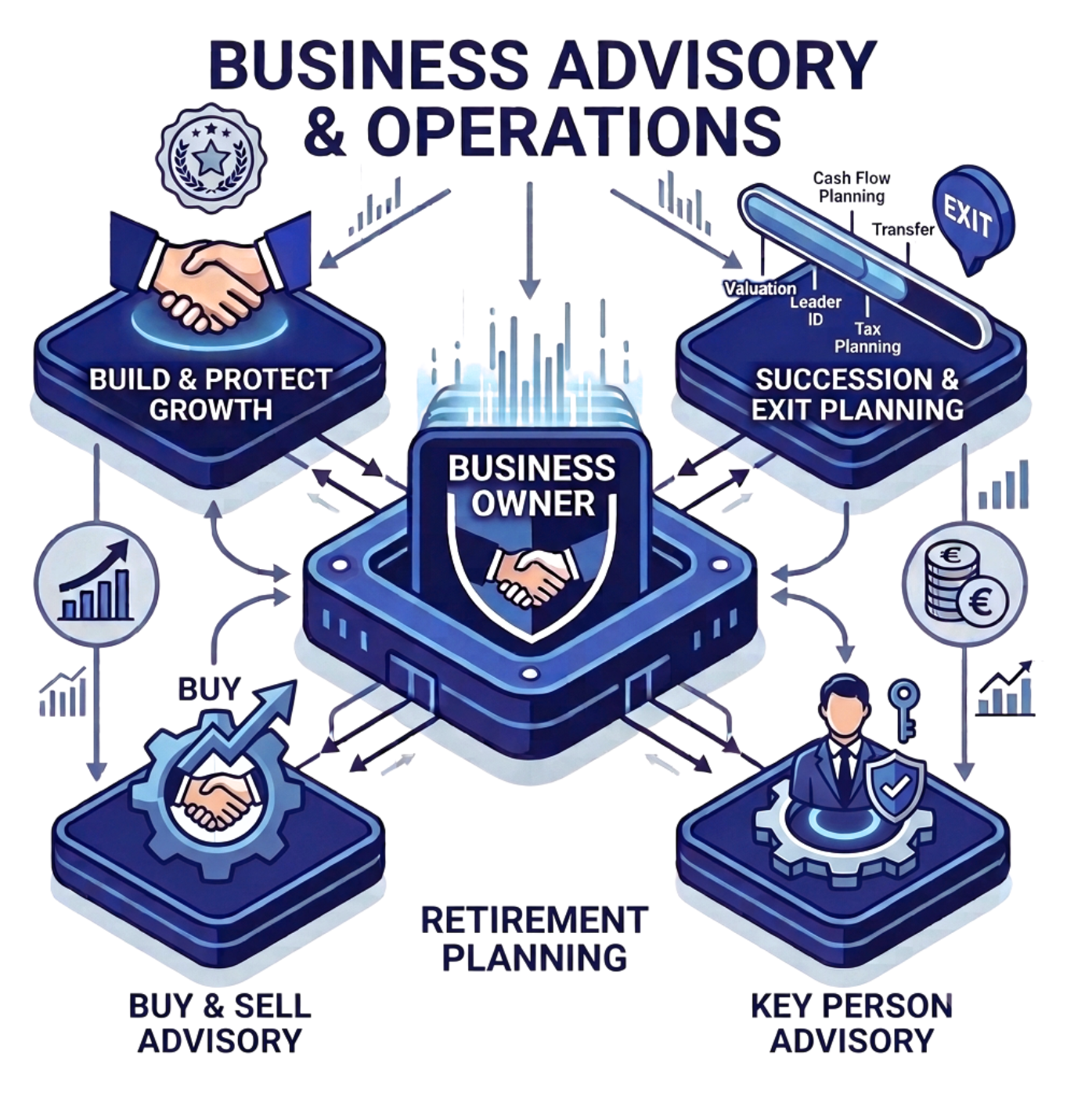
In many businesses, one person may carry a large share of client relationships, revenue generation, leadership, or decision-making. If that person becomes unavailable due to death, disability, retirement, or an unexpected departure, the business may face operational and financial strain.
A business continuity plan can help identify key-person risks and organize potential planning considerations, including succession planning, buy-sell agreement funding, key-person insurance, liquidity needs, and the owner's retirement income strategy.
When appropriate, investment accounts may also be reviewed as part of the broader planning process to evaluate liquidity, diversification, risk exposure, and long-term financial objectives.
All investing is subject to risk, including the possible loss of the money you invest. No strategy assures a profit or protects against loss. This material is for general educational purposes and is not a recommendation, offer, or solicitation.
02 · Why Life Capitalized
Before financial services, Troy Barrow led hotel and restaurant operations where payroll, budgets, team performance, and margins mattered every day. That experience informs the work Life Capitalized Financial does with business owners today.
We help owners review the financial questions that affect both the business and the family behind it: continuity planning, key-person risk, succession, retirement savings, liquidity, and the role the business may play in a future exit. The aim is to replace loose ends with a plan you can evaluate and act on.
Meet Troy03 · Business succession planning
You are the visionary, the problem-solver, the one who keeps it all moving. Without a succession strategy, a retirement plan, or an exit roadmap, everything you built is fragile. This can be prevented if you plan for it now.
You didn't build this business just for income. You built it to:
We help you explore buy-sell agreement strategies and key-person insurance to build a resilient future for all involved.
Schedule a continuity reviewDisclosure: This communication is for informational purposes only and should not be considered investment, tax, legal, or estate planning advice. Investment advisory services are offered through Hornor, Townsend & Kent, LLC (HTK). Insurance and other services may be offered separately through Life Capitalized Financial, where appropriately licensed. Clients should consult their tax and legal professionals regarding their individual circumstances.
04 · Take charge of your retirement
Don't spend so much time working on your business that you sacrifice your personal goals. When you're ready to sell and step back, you may be left without an exit plan.
If your business can't run without you, it isn't a business. It's a job you can't quit.
We help you build tax-smart systems, identify successors, and create a transition timeline so you can gradually reduce involvement without losing income or control.
Start your retirement plan05 · Decision guides
Short guides for the planning questions that can affect retirement, liquidity, and continuity.
Review whether a future sale can support your retirement plan.
Think through liquidity and continuity before a disruption.
Coordinate retirement savings with salary, profit, and employees.
06 · Common questions
A solo 401(k) can be a strong option for an S Corp owner with no full-time employees other than a spouse, since it allows both employee and employer contributions and can support higher total contribution limits than a SEP IRA in some salary scenarios. The right structure depends on your W-2 salary versus distribution split, whether you plan to hire employees, and your cash flow.
Read the S Corp owner retirement plan guide.
This is educational information, not personal advice. A solo 401(k), SEP IRA, and SIMPLE IRA each carry different rules and deadlines — review your specific numbers with a tax advisor before choosing.
S Corp owners typically pay themselves a reasonable W-2 salary (subject to payroll tax) and take remaining profit as distributions, which avoid self-employment tax but are still subject to federal and state income tax. Many owners set aside 25–35% of net profit for combined tax obligations, though the right percentage depends on total income, state taxes, and filing status. The IRS requires a "reasonable salary" — setting it too low is a common audit trigger.
This is educational information, not personal advice. A tax professional can calculate your specific withholding and estimated payment needs.
Common options include a SEP IRA (simple to administer, employer-funded only), a SIMPLE IRA (lower contribution limits, required for businesses under 100 employees), and a solo or standard 401(k) (higher contribution ceilings, more administrative complexity). The best fit depends on business size, profit consistency, and whether you want to maximize your own contributions or also benefit staff.
Read the S Corp owner retirement plan guide.
This is educational information, not personal advice. Review your options with a retirement plan specialist.
A buy-sell agreement is a legal contract that determines what happens to a business owner's share if they die, become disabled, retire, or otherwise leave the business. Without one, an owner's stake can pass to an unprepared heir, trigger disputes among remaining owners, or force a fire-sale valuation. Buy-sell agreements are often funded with key-person or life insurance so the remaining owners or the business can afford the buyout without straining cash flow.
Read the buy-sell and key-person planning guide.
This is educational information, not personal advice. The right structure depends on your entity type, number of owners, and state law.
07 · Disclosure
This material is for general educational purposes and is not a recommendation, offer, or solicitation. HTK does not provide legal and tax advice. Always consult a qualified tax advisor regarding your personal tax situation and a qualified legal professional for your personal estate planning situation.